

Behind the Publication: Single atoms of indium on hafnia enable superior CO2-based methanol synthesis
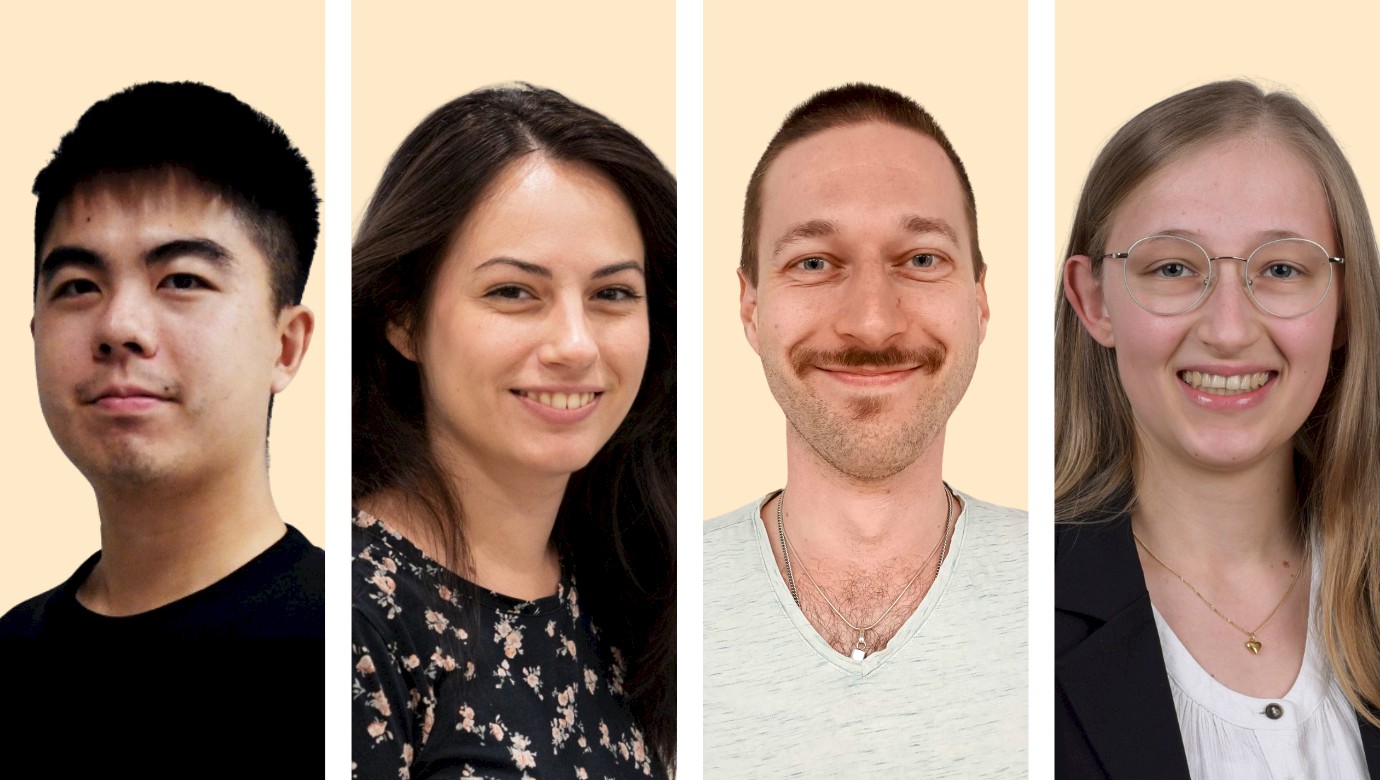
PhD researchers from the team, from left to right: Adam (Yung-Tai) Chiang, Milica Ritopecki, Patrik Willi, and Katja Raue.
Three NCCR Catalysis groups, together with collaborators from ICIQ (Spain) and Empa, recently discovered a new catalytic architecture for green methanol synthesis that utilizes single-atom catalysis with a more efficient active site. In this Behind the Publication feature, Adam (Yung-Tai) Chiang (aCe lab, ETHZ), Milica Ritopecki (TheorHetCat Group, ICIQ), Patrik Willi (Functional Materials Laboratory, ETHZ), and Katja Raue (EPR Research Group, ETHZ) share the story behind the discovery and what it could mean for the future of sustainable methanol production.
Can you please tell us about yourselves and your role within this project?
Adam: Originally from Taiwan, I am currently in the third year of my PhD in the group of Prof. Javier Pérez-Ramírez. My research focuses on green methanol synthesis and single-atom catalysis, both of which contribute to advancing sustainable chemistry and the transition toward more environmentally responsible chemical processes. Within this project, I coordinate experimental efforts across different research groups and stages of the investigation, aligning objectives and consolidating results.
Milica: I am a second-year PhD student at the Institute of Chemical Research of Catalonia (ICIQ-CERCA) in Tarragona, Spain, in the group of Prof. Núria López. My research focuses on atomistic modelling of heterogeneous catalysts. In this project, I was responsible for the theoretical work, developing realistic models of atomically dispersed indium sites and using simulations to understand their structure and catalytic behaviour.
Patrik: I am currently in the final year of my PhD with Prof. Wendelin Stark. I was originally trained as an organic chemist, but for my PhD, I transitioned into chemical engineering to work on more application-driven problems. In this project, I used flame spray pyrolysis (FSP) to prepare some of the materials we studied. This powerful technique allows us to produce comparable materials quickly while ensuring reproducibility and scalability.
Katja: I am a second-year PhD student in Prof. Gunnar Jeschke’s group, where I use electron paramagnetic resonance (EPR) spectroscopy to better understand different catalytic systems. In this study, I investigated how this superior catalyst differs from established systems (e.g., ZnZrOx and InZrOx), which we had previously measured by tracking paramagnetic intermediates throughout the reaction. Using EPR, we can focus on oxygen vacancies, which are usually difficult to detect with other techniques.
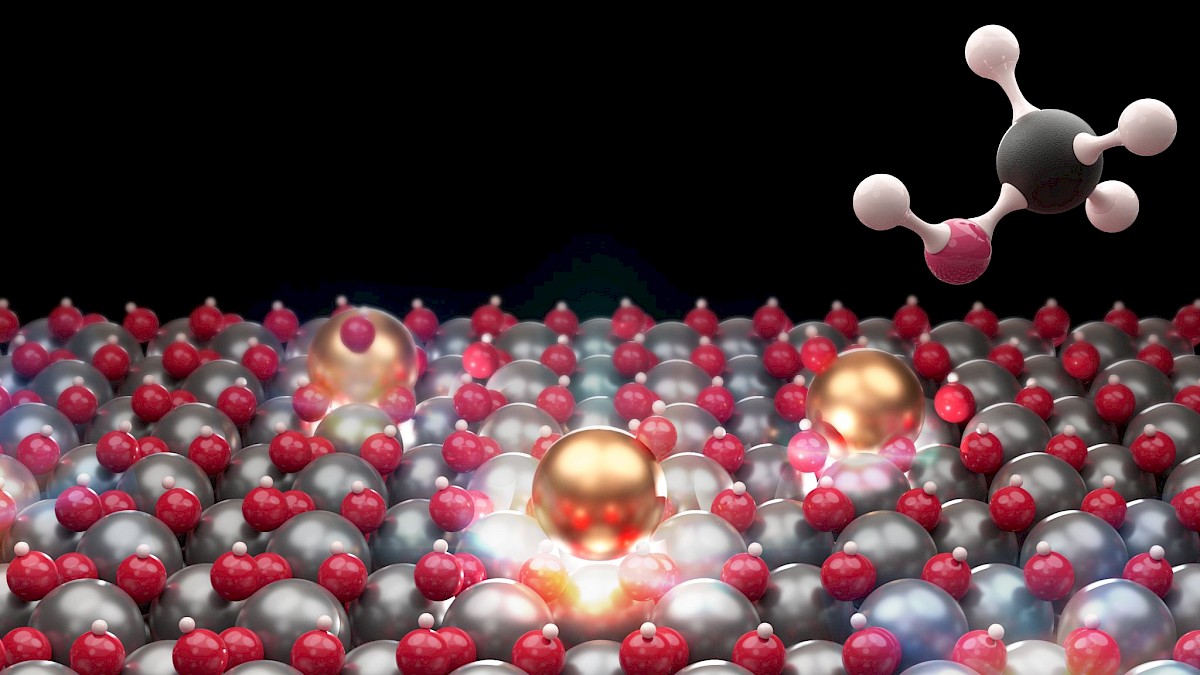
The breakthrough: indium single atoms on monoclinic hafnium oxide achieve unparalleled methanol productivity via CO2 hydrogenation.
Can you explain the significance of your discovery and how it differs from previous work on indium oxide catalysts?
Adam: Sustainable chemical transformations, such as CO2-based methanol synthesis, are a cornerstone of the decarbonization of the chemical industry. Over the past decade, indium oxide supported on monoclinic zirconia has ranked among the most stable and selective catalytic systems. Previously, zirconia was believed to be the only support capable of effectively promoting indium oxide. Here, however, we report a new class of catalytic materials: hafnia-supported indium single atoms. We demonstrate that hafnia provides a strong promotional effect for indium single atoms, even surpassing the performance of the established zirconia support. Through advanced experimental and theoretical analyses, we show that this enhanced catalytic performance arises from the synergistic coupling of atomically precise material engineering with high-κ dielectric oxides.
What are single-atom catalysts, and what is the motivation for this work?
Adam: Single-atom catalysts are a class of nanostructured materials in which catalytically active species are atomically dispersed on a support, enabling maximal atom efficiency. These systems feature low-nuclearity metal species whose catalytic performance is strongly governed by their interaction with the support, making structure-performance relationships highly sensitive to the physicochemical properties of the carrier. The motivation of this work is to elucidate the structure-performance relationship of indium-hafnium catalysts for CO2 hydrogenation by controlling the catalyst nanostructure via flame spray pyrolysis. In contrast to previous reports, where indium oxide clusters or patches were identified as the optimal active sites, we demonstrate that indium single atoms on hafnia exhibit the highest methanol productivity. These findings bridge single-atom catalysis and green methanol synthesis, providing new design principles for advanced reducible oxide catalysts.
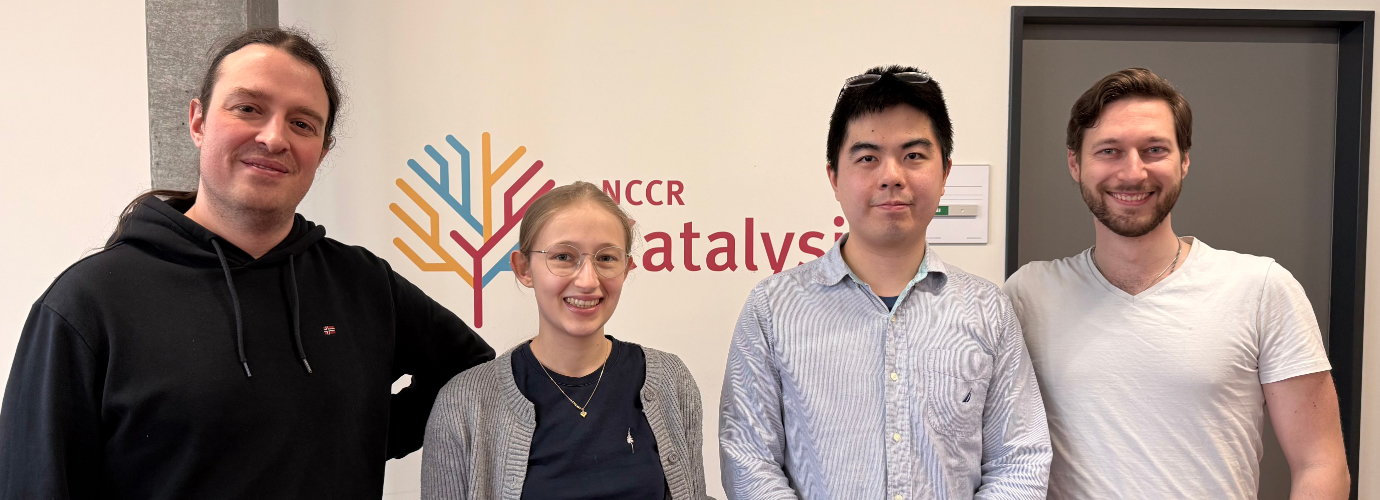
Group photo of some of the researchers, from left to right: Dr. Mikhail Agrachev, Katja Raue, Adam (Yung-Tai) Chiang, and Patrik Willi.
Which was the main challenge? How did you address it?
Adam: The main challenge was understanding the synthesis-performance relationship of indium-hafnium oxide catalysts. Initially, we used a conventional impregnation approach to disperse indium oxide on monoclinic hafnia on isostructural supports, but even after extensive optimization, these catalysts were largely inactive. Through collaboration within the NCCR Catalysis network, we partnered with the Stark group to use flame spray pyrolysis to produce catalysts that were highly active and stable, outperforming zirconia-supported systems. Surface vibrational spectroscopy and adsorption studies showed that enhanced surface hydroxylation drives this unique synthesis-structure-performance relationship. Tackling this challenge required close interdisciplinary collaboration across synthesis, catalysis, and surface characterization.
Milica: The main computational challenge came from the large configurational space of indium single atoms on monoclinic supports. The flexible coordination of indium and the monoclinic surface create many possible structures, oxygen-vacancy arrangements, and surface hydroxylation states. To tackle this, we used a systematic modeling strategy combining density functional theory with ab initio thermodynamics to identify the most relevant configurations under reaction conditions. Continuous feedback from experiments guided the models, allowing meaningful comparisons between simulations and observed catalytic behavior.
Patrik: For a long time, I faced the challenge of obtaining sufficient high-purity Zr and Hf precursors. Discussing this issue with other members of our group led to alternative preparation routes - approaches I would not have considered on my own.
Katja: The results from my EPR measurements were highly unusual, especially compared to our previous experiments, as we observed no changes throughout the reaction. This puzzle could only be resolved by combining the EPR data with other techniques, such as XANES, highlighting the importance of scientific collaboration among experts from different fields.
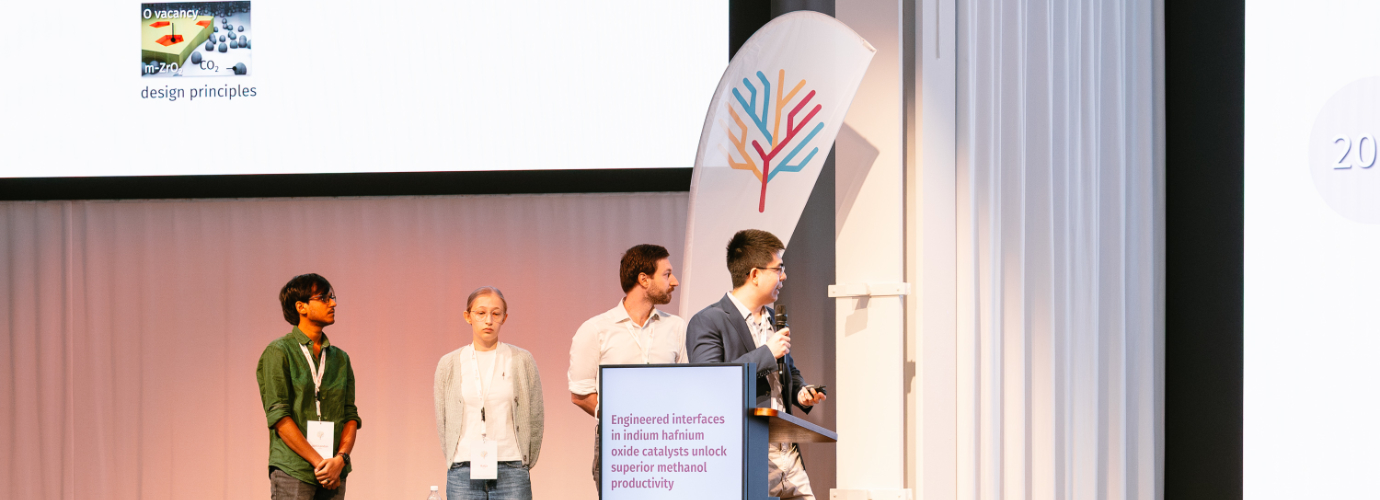
Some of the researchers presenting the work at the Y5 Annual Review Meeting, from left to right: Abhinandan Nabera, Katja Raue, Patrik Willi, and Adam (Yung-Tai) Chiang.
As junior researchers, what did you learn from this collaboration?
Adam: My main takeaway from this collaboration is that while one can move fast alone, truly impactful science requires going far together. This project illustrates a catalysis problem that demands expertise across multiple disciplines, from experimental catalysis and materials synthesis to theoretical chemistry. In hindsight, several key challenges could not have been tackled by a single researcher or group. The collaborative framework of NCCR Catalysis was crucial in fostering open communication among PhD students and researchers from diverse backgrounds. This teamwork not only strengthened the scientific outcome but also reshaped how I approach problem-solving.
Milica: I gained a deeper understanding of experimental techniques and the insights they provide, which helped me design and interpret computational models more realistically. It was also my first time working in a large multidisciplinary team, where I learned to communicate across expertise areas and integrate complementary results into a coherent story. Developing resilience was another key learning. There were moments when results were inconclusive or hypotheses did not hold. Learning to adapt strategies and keep moving forward despite uncertainty was one of the most valuable outcomes of this project.
Katja: This project reminded me that understanding complex catalytic systems requires a team with complementary expertise. Working with a spectroscopy technique that is still underrepresented in catalysis, I was already aware of this in principle. However, witnessing such interdisciplinary collaboration in practice was truly empowering, and I am very grateful to have been part of it.
What makes this work particularly relevant for NCCR Catalysis and the research community?
Adam: This work highlights the strength of an interdisciplinary, collaborative research framework. The project brought together researchers with complementary expertise in materials synthesis, catalytic engineering, theory, and spectroscopy, and our frequent discussions often led to valuable insights and progress. Beyond the collaboration itself, the study shows how integrating experimental and theoretical approaches can significantly advance our understanding of heterogeneous catalysis. Importantly, the design principles emerging from this work suggest that oxide supports comparable to, or even surpassing, zirconia can be systematically identified.
Patrik: The work is another nice example of NCCR Catalysis bringing together complementary expertise within the network, combining different approaches to address complex questions. Only these types of highly interdisciplinary collaboration enable progress that would be difficult to achieve within a single group.
Katja: This project shows that research of this kind can only succeed through collaboration. In my experience, it is less common to have collaborations involving more than two groups. I think the research community can learn from this example and pursue more interdisciplinary projects alongside work within their own areas of expertise.
Publication details:
Single atoms of indium on hafnia enable superior CO2-based methanol synthesis. Y.T. Chiang, M. Ritopecki, P.O. Willi, K. Raue, J. Morales-Vidal, T. Zou, M. Agrachev, H. Eliasson, J. Wang, R. Erni, W.J. Stark, G. Jeschke, R.N. Grass, N. López, S. Mitchell, J. Pérez-Ramírez. Nat. Nanotechnol. 2026. DOI: 10.1038/s41565-026-02135-y.
 tweet
tweet